
 |
Are Portable Solar Panels Worth It? A Detailed Look
Understand efficiency, practical applications, and what to expect from these power sources.
Do you find yourself off-grid, wanting a reliable power source to keep your devices charged or your small appliances running? Portable solar panels sound very good. They offer independence from the power grid.
Beyond marketing claims, do these devices deliver on their promises of efficiency and utility in real situations? Many wonder if they are a good investment or just a new gadget.
This guide addresses the facts. It explores the potential and limits of portable solar technology. This helps you decide if it suits your energy needs.
In a connected world, the appeal of self-sufficiency, especially for power, is strong. Portable solar panels have become popular. They promise the freedom to generate electricity wherever the sun shines. Campers, RV enthusiasts, those preparing for emergencies, or people wanting to reduce their carbon footprint show high interest in these compact power generators. With any new technology, one question remains: Are portable solar panels worth it?
This guide explores the practical use, performance, and value of portable solar solutions. It shows you past marketing to reveal what these devices achieve. It shows their limits. It helps you decide if they are the correct investment for your energy needs. Learn about wattage, efficiency, and real applications. This gives you the knowledge to make a decision.
Quick navigation
Understanding Portable Solar Panels: Are They Useful?
Portable solar panels are renewable energy technology for mobility and convenience. They differ from rooftop panels. They are lightweight, foldable, and easy to set up. This makes them good for temporary power away from main grids. They offer a solution for many situations where you have no power or little power. What are these devices? How do they use sun energy? Do these compact power stations truly change off-grid living, or are they just a convenience with few uses?
They work. Portable solar panels use the same photovoltaic (PV) principle as larger solar setups. They convert sunlight directly into electricity using semiconductor materials; silicon is common. Their design focuses on portability. They come in various forms, from small, rigid panels for charging phones to larger, flexible, or suitcase-style panels for larger power needs. A complete portable solar system includes the panel itself, a charge controller to regulate voltage and protect batteries, and sometimes an inverter to convert DC electricity to AC. You plug in standard household appliances with it.
The differences between portable and rigid panels are more than just size. Portable panels use different materials for durability and flexibility outdoors. They use monocrystalline cells for higher efficiency in direct sunlight. They use polycrystalline cells which cost less. Some portable options use thin-film technology. This offers flexibility but lowers efficiency. Understand these differences to see their capabilities. Decide if they fit your mobile, self-sufficient power needs.
These panels offer energy independence. You can camp without your phone dying. You have a reliable power source for key appliances during an outage. This constant, clean energy drives many to consider portable solar. It is important to look past this image. Examine their real-world performance.
The Real-World Performance: Do They Deliver?
Marketing for portable solar panels highlights wattage figures and high efficiency. These numbers are accurate in labs. Real-world performance varies greatly. Sunlight, panel angle, temperature, and minor shading impact your panel's power output. Do these flexible arrays meet your energy demands when you are far from a power outlet?
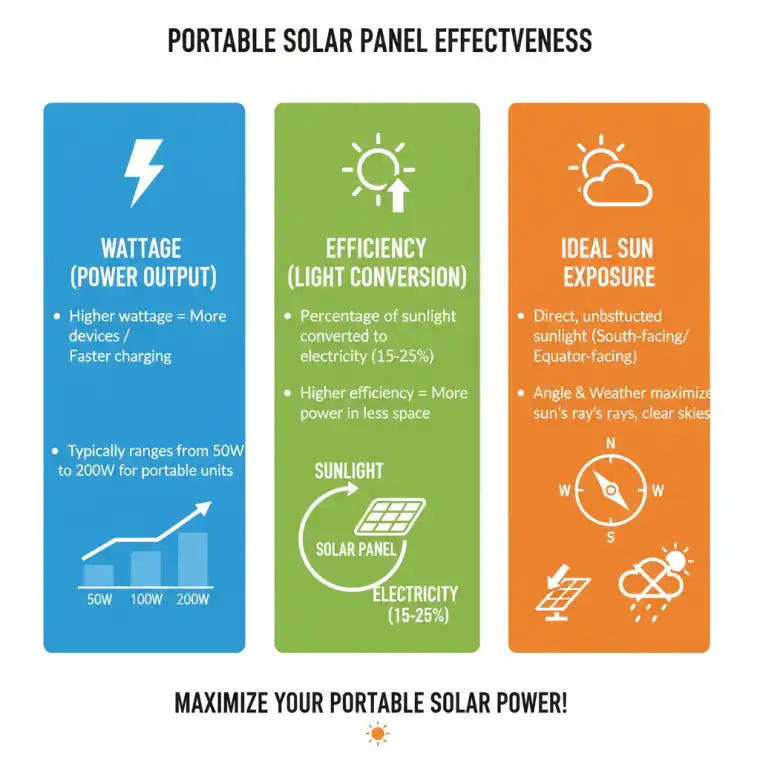
Typically, a portable solar panel achieves 70-85% of its advertised wattage in good, steady sunlight. Cloud cover, time of day, and geographical location are important. For instance, a 100W solar panel (like a Portable 100W Solar Panel often seen in camping setups) produces between 50-80 watts per hour in good conditions. This output suffices for charging smaller devices, maintaining a deep cycle battery, or running low-power appliances. Powering high-wattage items like electric kettles or hair dryers is beyond their sustained capacity.
Understanding power output expectations is important for managing your off-grid energy needs. For charging phones, tablets, or small cameras, even a 20-50W panel is sufficient over several hours. For laptops or maintaining a small RV battery, a 100W to 200W setup is recommended. If you run a portable fridge for long periods, you need a 100W panel. Pair it with a strong power station. Manage your energy use carefully. Consider the panel's wattage. Also consider the battery's capacity and your devices' power draw. Understand portable solar use. Approach other solar investments with clarity. Debunk myths about solar investments to make good choices.
To optimize performance, do more than buy a high-wattage panel. Angle it correctly towards the sun. Keep the panel clean. Avoid shadows; a small shadow reduces output. These steps maximize efficiency. The charge controller and battery system also impact how well you store and use solar energy. Without a well-matched system, even a strong panel performs poorly.
Practical Applications: Powering Your Adventures and Home
Portable solar panels show their value in many practical uses. They do not replace a full home solar system. They add to your power supply in specific situations. From the wilderness to a power outage, where do portable solar panels work best?
For campers and backpackers, portable solar panels are useful. Compact, lightweight models fit into a pack. They provide enough power to keep phones, headlamps, and GPS devices charged. They ensure safety and connectivity in remote locations. RV owners benefit greatly from larger, suitcase-style portable solar panels. They top off leisure batteries. This extends time off-grid. You do not need a generator or shore power. This means longer stays in national parks or secluded spots. This gives RV travel more freedom. A typical Portable 100W Solar Panel is perfect for keeping an RV battery topped up during daylight hours, if you use moderate power.
Beyond recreation, portable solar panels are important in emergency preparedness. During power outages from storms or other disruptions, a reliable portable solar setup charges essential communication devices. It powers LED lights, and keeps small medical equipment running. This offers security and self-reliance when regular power sources fail. For backyard enthusiasts, these panels power outdoor lighting, small water features, or a laptop while working outdoors. They blend indoor and outdoor living.
When powering specific appliances, context matters. A portable fridge, for example, is a common target for portable solar setups in RVs or camping. A well-insulated, energy-efficient portable fridge, a 100W-200W solar panel maintains it over several sunny hours if paired with a good battery. Laptops and other moderately powered electronics charge directly or through a power station. Manage your expectations. These panels are good for trickle-charging and maintaining power levels. They do not rapidly recharge large energy banks. They do not continuously run high-draw appliances like microwaves or air conditioners. They are versatile. Remember their power output limits.
What this means for you
To understand portable solar panels, translate their technical specifications and performance into benefits and drawbacks for your situation. Who uses portable solar best? How do you know if this technology aligns with your lifestyle and energy needs? With many options, how do you find the setup that fits your off-grid goals?
If you are a camper, a weekend enthusiast with an RV, or someone who values preparedness for unexpected power disruptions, portable solar panels change your experience. They offer great flexibility and the peace of mind from generating your own power. For those who frequently work or relax outdoors and need to keep devices charged, a smaller, more compact panel extends your productive or leisure time. The financial investment is lower than a full residential system. It is an accessible entry into solar energy.
But, if your primary goal is to reduce your home's electricity bill greatly or power large, energy-intensive appliances for extended periods, portable solar panels are not enough. Their output, while valuable, is not designed for sustained heavy loads. In such cases, a more permanent, larger-scale solar installation is more appropriate. To scale up your solar infrastructure, understand how to get solar power for larger energy demands. This is key. Consider this, just as you consider solar power for larger energy needs.
Finally, the cost-benefit analysis depends on your use. For occasional off-grid trips, the investment in a portable panel and a power station pays for itself quickly. It removes the need for noisy, fuel-dependent generators or expensive campground hookups. For emergency backup, its value is the security and communication it provides. Weigh the initial cost against the convenience, independence, and reliability it offers. Match it to your unique requirements. Do not underestimate the psychological benefit of self-reliance for power. For many, this alone makes the investment worthwhile.
Choosing the Right Portable Solar Setup: Key Considerations
Choosing portable solar panels feels overwhelming. Many options exist. Invest in a system that meets your expectations and delivers reliable power. Several key considerations guide your decision. With many models, how do you choose a system that works for you?
First, assess your wattage requirements. Calculate the total power consumption of your devices. Look at the watt-hours (Wh) or wattage (W) ratings on your devices. Estimate your daily usage. Generally, a 100W panel starts you well for charging laptops and maintaining small batteries. 200W or more is necessary for long use of portable fridges or multiple devices. Always add buffer capacity for cloudy days or poor sun angles.
Next, consider the panel type and durability. Monocrystalline panels offer the highest efficiency. They are a solid choice for most users. Polycrystalline panels cost less but are slightly less efficient. Thin-film panels are very flexible and lightweight. They are excellent for specific applications where portability matters most. Their efficiency is lower. For rugged outdoor use, choose panels with strong construction, water resistance (IP ratings), and durable connections.
Battery compatibility and capacity are also important. Portable solar panels are rarely used alone. They typically charge a portable power station or a deep-cycle battery. Use LiFePO4 for better performance and longevity, or lead-acid for a cheaper option. Ensure your charge controller (often built into the panel or power station) works with your battery type and voltage. The battery's capacity must store enough energy to power your devices during non-sunny periods. Get expert insights into solar panel installation. This includes residential systems. It provides a deeper understanding of system integration and efficiency. Find valuable perspectives by exploring resources related to expert insights on solar panel installation.
Finally, consider your budget and brand reputation. The cheapest option is tempting. A reputable brand offers better quality, reliable customer support, and accurate product specifications. Read reviews. Compare warranties. Look for bundles that include a power station if you start from scratch. A well-chosen portable solar setup invests in your energy independence and outdoor lifestyle. Choose for long-term performance and satisfaction.
Risks, trade-offs, and blind spots
The benefits of portable solar panels are clear. It is important to acknowledge their limits, trade-offs, and common blind spots. They promise convenience. What challenges or compromises do you encounter with portable solar power?
A major limit is weather dependency. Solar panels require sunlight. Cloudy days, heavy rain, or dense tree cover reduce or halt power generation. You cannot rely on them as your only power source in all conditions. You need a backup power plan or a large enough battery bank for low sun periods. Charging speed is also a trade-off. Even a 200W panel does not charge a large power station as quickly as a wall outlet. This requires patience and good sun exposure.
Size and weight, paradoxically, become a limit for higher wattage portable panels. They are designed for portability. Still, a 200W or 300W foldable panel is large and heavy. It is less ideal for backpacking. It suits car camping or RVs better. There is also the risk of theft. This is true when panels are in exposed outdoor areas. Securing your investment is important.
Many common misconceptions exist about what portable solar panels do. Many users believe they offer "unlimited free power" for any appliance. The energy is free. The amount is limited by the panel's size and conditions. Powering heavy-duty appliances like air conditioners, electric heaters, or conventional microwaves directly from most portable setups is unrealistic. This leads to disappointment or damage to your equipment. Maintenance and longevity require attention, though generally low. Keeping panels clean from dust and debris is essential for best performance. Like any electronic device, they have a lifespan. It is long when you care for them properly.
Understanding these trade-offs does not deter. It fosters realistic expectations. Portable solar panels are excellent tools when you use them appropriately and within their design limits. Acknowledge these challenges. This helps you plan effectively. Integrate portable solar into your lifestyle in a way that serves your needs, without creating frustration.
Main points
Portable solar panels offer convenience and renewable energy. Their worth comes from understanding their capabilities and limits. They are not a one-size-fits-all solution. They are a tool for specific applications when chosen and used wisely.
- Portable solar panels are ideal for mobile, temporary power needs, different from permanent residential setups.
- Real-world performance is affected by environmental factors, often producing 70-85% of advertised wattage in good conditions.
- They are good for charging small devices, maintaining batteries for RVs/camping, and powering low-wattage appliances like portable fridges during outages.
- A 100W portable solar panel is a popular choice for balance between portability and moderate power needs.
- Calculate wattage needs. Consider panel durability. Ensure battery compatibility. Evaluate brand reputation. This helps you choose the right setup.
- Key trade-offs include weather dependency, charging speed limitations, and the size/weight of higher-wattage systems.
- Portable solar panels are not designed to power heavy-duty household appliances for extended periods.
- For adventurers, emergency preparedness, and off-grid enthusiasts, the value of energy independence outweighs the initial investment and minor inconveniences.
Use the sun's power your way. Evaluate your needs. Understand the technology. Invest in a portable solar setup that empowers your adventures and keeps you connected, wherever life takes you.