

How Online Traders Use Event Prediction Markets: A Comprehensive Guide
Navigate the world of prediction markets and learn how traders leverage them for insights and potential profits.
Do you wish you could see the future? Event prediction markets offer a look at what the crowd thinks will happen.
These markets are not just for fun. They are tools used by online traders to measure sentiment and potentially profit from predicting outcomes.
We will go in-depth on how these markets work and how you can get involved, from politics to finance.
Event prediction markets, sometimes called information markets or prediction markets, let people trade contracts. The payouts depend on what happens in the future. These markets show collective wisdom. They can be good at predicting events. This guide explains how online traders use event prediction markets. It covers the basics and advanced strategies.
Quick navigation
- What are Event Prediction Markets?
- How Do Prediction Markets Work?
- Legality and Regulation of Prediction Markets
- Prediction Markets vs. Gambling: Key Differences
- Tax Implications of Trading in Prediction Markets
- Strategies Used by Online Traders
- How Prediction Market Platforms Generate Revenue
- What this means for you
- Risks, trade-offs, and blind spots
- Main points
What are Event Prediction Markets?
Event prediction markets are online platforms. People can trade contracts that pay out based on if an event happens. These markets gather information from participants. They give insights into the chances of future events. Prices in these markets show the chance of an event happening. This gives traders and analysts useful information. For example, a contract might pay $1 if a political candidate wins. It pays $0 if they lose. The contract price changes with supply and demand. This shows what the market thinks about the candidate's chances.
These markets cover many events. These include elections, economic numbers, sports results, and product release dates. They are often seen as more accurate than polls or expert opinions. This is because participants risk their money. This encourages them to find and share information that could change the outcome.
How Do Prediction Markets Work?
Prediction markets use supply and demand. Traders buy and sell contracts about what will happen. These contracts are often called 'shares.' They show a probability. The contract pays out if the event happens. If it does not, the contract is worth nothing. Market prices show the collective wisdom of the participants.
Here is a simple explanation:
- Contract Creation: A prediction market platform creates contracts for specific events. For instance, a contract could be created for whether a company's stock price will exceed a certain value by a specific date.
- Trading: Traders buy and sell these contracts. The price of a contract is usually between $0 and $1. The price shows the market's estimated chance of the event happening. If a contract is trading at $0.70, it means there is a 70% chance the event will happen.
- Outcome Determination: Once the event happens, the contracts settle. Contracts that predicted the correct outcome pay out, usually $1 per share. Incorrect predictions result in zero payout.
- Price Discovery: The continuous trading and price changes show the market's collective forecast. Changes in price show new information and the changing opinions of market participants.
Legality and Regulation of Prediction Markets
The legality of event prediction markets varies by location. Some places allow and regulate them. Others restrict or ban them. Regulations often depend on how these markets are classified. Are they financial instruments, gambling, or something else? Because of this, it is important to research the rules in your location.
Regulators often want to prevent market manipulation, ensure fairness, and protect investors. Regulatory bodies may require Know Your Customer (KYC) procedures. They may also restrict the types of events traded and prevent insider trading. Some locations may require platforms to be licensed and follow financial regulations. This area is complex and always changing. Traders should stay informed about the latest legal developments.
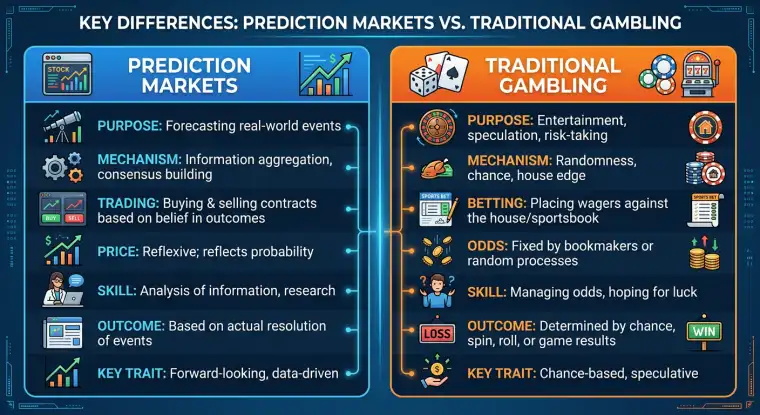
Prediction Markets vs. Gambling: Key Differences
Prediction markets and gambling have similarities. Both involve risk. However, they are different. The main difference is the information used to make decisions. Gambling depends on luck. Prediction markets use information and analysis to predict outcomes. Do you agree with this?
Here is a comparison:
- Information: Gambling is based on chance. Prediction markets are based on information and market sentiment.
- Skill: Skill is important in prediction markets. Traders use analysis and insights to make predictions. In gambling, skill can have an effect, but it is usually small.
- Transparency: Prediction markets are more transparent. Prices show the collective knowledge of participants. In gambling, information is often limited.
- Market Efficiency: Prediction markets can be efficient. They quickly include new information. Gambling markets often are not.
Tax Implications of Trading in Prediction Markets
Trading in prediction markets may have tax implications. These depend on your location and the specific rules. Profits from these markets are usually taxable income. It is important to understand how your earnings are taxed. This helps you follow tax laws. What records should you keep for taxes?
Here is what you need to consider:
- Taxable Income: Profits from prediction market trading are typically considered either capital gains or ordinary income. This depends on how often you trade.
- Reporting Requirements: You may need to report your trading activity and profits on your tax return.
- Record Keeping: Keep accurate records of all trades. Include dates, amounts, and outcomes.
- Consult a Tax Professional: Because this is complex, talk to a tax advisor. They can explain the specific tax implications in your location.
Strategies Used by Online Traders
Successful online traders in prediction markets use different strategies. These strategies often involve analyzing information, watching market trends, and managing risk. Can you think of any strategies that could be used?
Here are some popular strategies:
- Fundamental Analysis: Researching the factors that may influence an event's outcome. For example, if predicting the success of a new product launch, fundamental analysis might involve evaluating market research, competitor analysis, and consumer trends.
- Technical Analysis: Using charts and patterns to identify trading opportunities. Technical analysis in prediction markets involves analyzing price movements and volume data to predict future price changes.
- Sentiment Analysis: Measuring market sentiment by watching news, social media, and other sources. Understand how the market feels about an event's outcome.
- Arbitrage: Taking advantage of price differences between prediction markets. This involves buying and selling contracts at the same time on different platforms. Profit from price differences.
- Diversification: Spreading risk by trading across multiple markets and events. Diversification helps reduce the impact of any losing trade on your overall portfolio.
- Value Investing: Identifying contracts that are undervalued based on your assessment of the event's likelihood.
How Prediction Market Platforms Generate Revenue
Prediction market platforms have ways to generate revenue. This helps them maintain and grow their services. These revenue models are important for these platforms to continue. How do these platforms generate revenue?
- Transaction Fees: The most common way to make money is by charging fees on trades. This can be a percentage of the transaction amount or a fixed fee per trade.
- Market Making: Some platforms act as market makers. They provide liquidity by quoting bid and ask prices. They profit from the spread between the bid and ask prices.
- Premium Features: Offering premium features, such as advanced analytics tools, exclusive market data, or faster trade execution, for a subscription fee.
- Data Licensing: Selling market data and insights to third parties, such as news organizations, research firms, or institutional investors.
- Advertising: Displaying advertisements on the platform.
What this means for you
Understanding event prediction markets can be valuable. It does not matter if you are a casual observer or a serious trader. These markets provide insights into collective sentiment. These insights can inform decisions in various fields. They can also provide potential chances to make a profit. So, what should you do with this information?
If you are interested in trading, prediction markets offer an investment option. The key is to understand the risks and develop strategies. If you are interested in following events, these markets provide real-time information. They also offer insights into what the market thinks will happen.
Risks, trade-offs, and blind spots
Event prediction markets offer unique opportunities. They also have risks and potential problems. Knowing these can help you manage your expectations. They can also help you make informed decisions. What are some of these risks?
Here are some important areas to know about:
- Market Manipulation: Like other financial markets, prediction markets can be manipulated. Traders with a lot of money might try to change prices.
- Liquidity Risk: Some markets might not have enough trading. This makes it hard to buy or sell contracts at the prices you want.
- Information Asymmetry: Not everyone has the same information. Some traders may have better insights or faster access to data.
- Black Swan Events: Unforeseen events can greatly impact outcomes. This can lead to unexpected losses.
- Emotional Trading: Letting emotions affect trading decisions can lead to poor outcomes.
- Regulatory Uncertainty: Changes in regulations can affect the legality and operation of prediction markets.
Main points
Event prediction markets offer a look at the collective wisdom of crowds. For online traders, these markets can offer a way to invest and gain insights into future outcomes. Always stay informed and manage your risks.
- Event prediction markets let traders bet on the outcome of future events.
- These markets work by trading contracts that pay out based on the outcome of an event.
- The legality of prediction markets varies. Research the rules in your area.
- Prediction markets are different from gambling because they use information and analysis.
- Profits from prediction markets are usually taxed. Keep accurate records.
- Traders use strategies like fundamental and technical analysis.
- Prediction market platforms generate revenue through transaction fees, market making, and other methods.
- Be aware of market risks, including manipulation, liquidity issues, and black swan events.
Are you ready to explore prediction markets? Start by researching platforms. Understand the risks and create a trading strategy. Consider checking out solar financing myths, solar power for large homes, and solar panel installation in Houston to learn more about a different market.