

Solar ROI Calculator: Calculating Your True Return on Investment for a Brighter Future
A detailed look into assessing the financial viability of solar panels, understanding key ROI factors, and choosing the right calculation tools.
Considering solar panels for your home is a smart move, but how do you truly measure the financial payoff beyond just lower bills? Understanding your return on investment is the real key to realizing its full potential.
The promise of free sunshine sounds great, but turning that into tangible savings and increased property value requires precise financial foresight. Are you equipped with the right tools to calculate your solar success?
From federal tax credits to local incentives, the financial landscape of solar is rich with opportunities, yet navigating it to determine true profitability can feel like a complex puzzle. What if you had a clear roadmap to quantify your gains?
The appeal of solar energy is clear: reduced electricity bills, a smaller carbon footprint, and enhanced energy independence. Yet, for many homeowners, the initial investment can seem significant. Beyond the environmental benefits, the practical question always arises: Will going solar be a sound financial decision? This is where a robust Solar ROI Calculator becomes not just a tool, but an essential guide.
Understanding your return on investment (ROI) for solar panels is crucial for making an informed decision, extending far beyond simply knowing your monthly energy savings. It encompasses many financial factors, incentives, and long-term value propositions that can make or break the economic viability of your installation. This detailed guide will walk you through the essentials of solar ROI, explain the key factors that influence it, and help you navigate the various calculation tools available, from online platforms to detailed "Solar ROI calculator Excel" spreadsheets, helping you confidently assess and maximize your solar investment.
Quick navigation
The Essentials: What is Solar ROI and Why Does it Matter?
Return on Investment (ROI) is a fundamental financial metric that measures the profitability of an investment. For solar energy, it quantifies the financial gain or loss you can expect relative to the initial cost of installing your solar panel system. While phrases like "payback period" (the time it takes for savings to offset the initial cost) are often used interchangeably, ROI offers a more comprehensive financial picture, factoring in not just the time to break even, but also the total accumulated financial benefits over the system's lifespan.
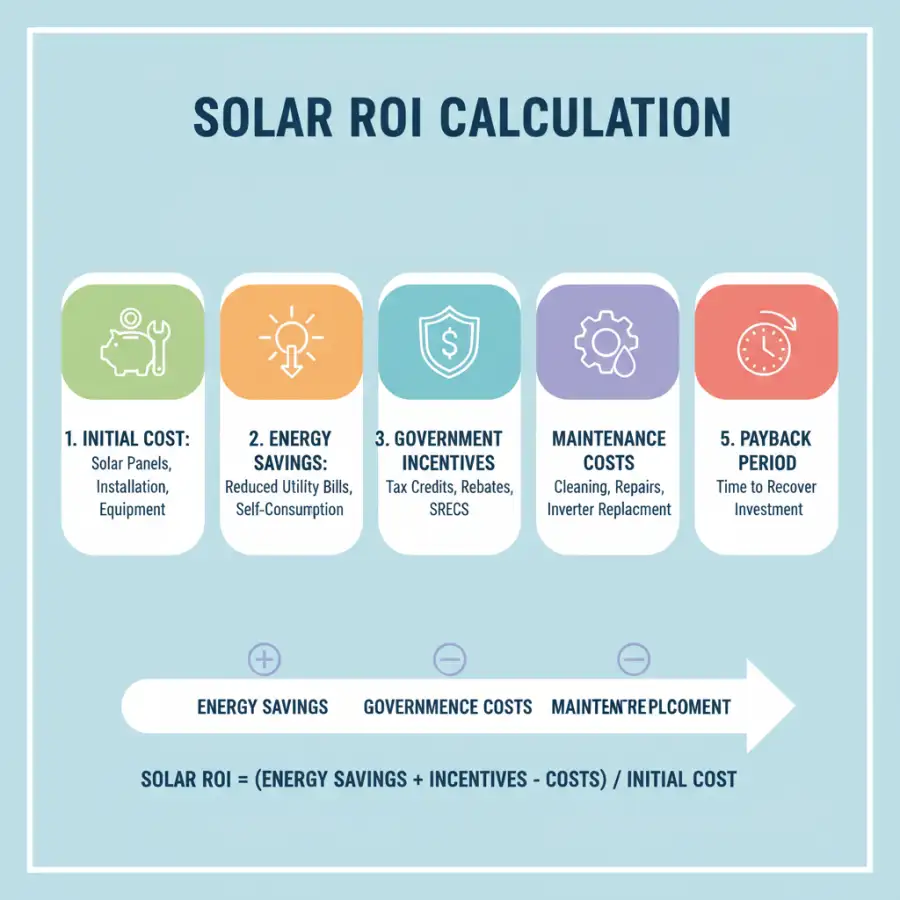
Understanding solar ROI means looking beyond just your reduced monthly electricity bill. It involves calculating the cumulative value generated by your system, which includes several key components. Firstly, there are the direct energy bill savings, which can be substantial, especially as utility rates continue to rise. Secondly, critically important are the various incentives available, such as the federal solar Investment Tax Credit (ITC), state tax credits, local rebates, and potential Solar Renewable Energy Credits (SRECs). These incentives can significantly offset the upfront cost, directly boosting your ROI.
Beyond these direct financial benefits, solar panels can also increase your home's property value, offering a measurable increase in asset value. In many housing markets, homes with owned solar systems sell faster and for a higher price. Furthermore, by locking in your energy costs, you effectively insulate yourself from future utility rate increases, providing long-term financial stability that contributes to your overall return. A robust ROI calculation considers all these elements, painting a complete picture of your solar investment's true worth. How does understanding this comprehensive ROI transform a simple purchase into a strategic long-term investment that secures your financial and energy future?
Key Factors Driving Your Solar ROI
The profitability of your solar investment isn't determined by a single variable; rather, it's a combination of numerous factors. Each element contributes significantly to your overall Return on Investment, making it crucial to understand their individual and collective impact when using any Solar ROI Calculator.
The **Initial System Cost** is naturally a primary factor. This includes the purchase price of your panels, inverter, mounting hardware, and batteries (if applicable), along with installation labor. Higher quality, more efficient equipment may have a higher upfront cost but can offer greater long-term energy production and durability. Your **Energy Consumption** dictates how much electricity you currently use, which in turn determines the potential savings. A household with high electricity bills stands to save more, thus improving ROI. Closely related are **Electricity Rates**, both current and projected. Areas with high and rapidly increasing utility rates will see a quicker payback and higher overall ROI, as the savings from solar become more pronounced.
**Incentives** are perhaps the strongest drivers of solar ROI. The federal Investment Tax Credit (ITC) currently offers a substantial percentage of your system's cost as a tax credit. Beyond this, many states and local municipalities offer their own tax credits, rebates, and programs like Solar Renewable Energy Credits (SRECs) or robust net metering policies, where you get credit for excess energy sent back to the grid. These can drastically reduce the net cost and improve your return. Your geographic **Location** plays a critical role due to solar irradiance—the amount of sunlight your area receives. Naturally, sunnier regions like California or Florida offer higher energy production, boosting ROI. Local regulations, permitting costs, and specific utility policies also vary by location.
**System Performance and Degradation** refers to how efficiently your panels convert sunlight into electricity and how that efficiency might decrease over their lifespan (typically a very gradual 0.5-1% per year). Your **Financing Method** is equally crucial; a cash purchase yields the highest ROI due to no interest payments, while a loan’s interest rate and terms will impact your total cost. Leases and PPAs generally offer no direct ROI to the homeowner, as the third party owns the system. Finally, consider **Maintenance & Insurance**; while solar systems are relatively low-maintenance, factoring in occasional cleaning, inverter replacement, or unexpected repairs, along with increased homeowner's insurance (though often minimal), provides a more realistic ROI picture. Why do two identical solar systems, installed with the same equipment, often yield vastly different returns for homeowners simply because they are in different locations or were financed differently?
Choosing Your Solar ROI Calculator: Online Tools vs. Excel
With so many variables influencing your solar ROI, having the right calculation tool is essential. You essentially have two main categories of tools at your disposal: readily available online calculators and highly customizable spreadsheet options, often in the form of a "Solar ROI calculator Excel" template. Each has its strengths and weaknesses, catering to different levels of detail and user expertise.
**Online Solar ROI Calculators** offer exceptional ease of use. Websites from organizations like Project Sunroof (Google's solar initiative) or EnergySage provide quick, often location-specific estimates. You input basic information like your address, average electricity bill, and sometimes your roof type, and the calculator provides a projected system size, cost, and estimated savings or payback period. Their pros include accessibility, immediate results, and sometimes integration with local utility and incentive data. However, their cons are a lack of customization; they often use default assumptions for electricity rate increases, system efficiency, and incentive eligibility, which may not perfectly reflect your unique situation. They provide a good starting point but can sometimes be overly simplistic for a deep financial analysis.
For those seeking fine-grained control and detailed financial modeling, a **Spreadsheet Calculator (Solar ROI calculator Excel)** is an essential tool. These templates, often available for download, allow you to manually input every single variable: precise system costs, specific loan interest rates, projected utility rate increases, exact incentive amounts, and even panel degradation rates. This high level of customization enables comprehensive scenario analysis, allowing you to tweak variables and see how they impact your ROI. The cons are that they require more effort and a basic understanding of Excel formulas. Inputting accurate data can be tedious, but the precision gained is invaluable for a deep dive into your investment. When planning your residential solar panel installation, a detailed Excel model ensures you account for every component and cost.
Regardless of the tool, ensure you input accurate data for system size, actual quoted costs, your specific utility rates, and all applicable incentives. It's often wise to compare outputs from a few different online tools and then refine your analysis with a detailed spreadsheet. Understanding the assumptions behind any calculator is key to interpreting its results correctly. When does a quick online estimate fall short of providing the necessary depth, and when does a meticulously constructed Excel spreadsheet become an essential asset for confidently charting your solar journey?

What This Means for You
Understanding and accurately calculating your solar ROI isn't just an academic exercise; it has significant practical implications for your financial future and your home. This knowledge empowers you to make strategic decisions that directly impact your long-term savings, property value, and overall peace of mind.
A clear, high ROI calculated through a reliable solar calculator can provide the strong financial justification needed to move forward with a solar investment. It helps you see beyond the initial sticker price and appreciate the significant long-term financial stability and energy independence that solar offers. By effectively quantifying your future savings and asset appreciation, you can confidently commit to a greener, more economical household.
Furthermore, an informed ROI analysis puts you in a powerful position when negotiating with solar installers. When you understand the various factors influencing your return, you can ask targeted questions about equipment choices, system design, and the specific incentives they've included in their quotes. This allows you to compare offers not just on their sticker price, but on their projected financial performance over decades. This informed approach helps you secure the best possible deal and ensures you choose a reputable installer, a critical aspect often emphasized in guides about selecting the best solar roofing company.
Beyond direct financial gains, a positive solar ROI translates into increased home value, making your property more attractive to potential buyers should you decide to sell. It signifies a future-proofed home with lower operating costs and a reduced environmental footprint. Ultimately, understanding your ROI tailors the solar investment to your personal financial goals, whether you prioritize a quick payback period, maximum lifetime savings, or simply want to lock in predictable energy costs for years to come. How can a seemingly complex set of numbers empower you to make one of the most significant financial decisions for your home with complete clarity and confidence?

Risks, Trade-offs, and Blind Spots
While a solar ROI calculator provides invaluable projections, it's essential to approach the results with a critical eye, recognizing the potential risks, trade-offs, and "blind spots" that can emerge between calculation and real-world performance. No model is perfect, and acknowledging these caveats is vital for truly informed decision-making.
One significant area of divergence is between **estimates and reality**. Calculator projections are based on assumptions about future electricity rates, weather patterns, and system performance. Unexpected events, such as prolonged cloudy periods, increased shading from new construction, or grid outages, can lead to actual energy production falling short of estimates. Similarly, if utility rates don't increase as steeply as projected, your savings might be less than anticipated. The importance of a high-quality, professional residential solar panel installation cannot be overstated; a poorly installed system will directly impact performance and thus, your ROI.
**Policy changes** represent another substantial risk. Government incentives like the federal ITC, state tax credits, or net metering policies are subject to legislative changes. A reduction or elimination of these programs could significantly diminish your long-term ROI, especially if it occurs after your system is installed but before you've fully recouped the benefits. This uncertainty highlights the need to factor in potential policy shifts into your financial planning.
**System malfunctions and unexpected maintenance costs** are also potential blind spots. While modern solar systems are highly reliable, components like inverters have a shorter lifespan than panels and will eventually need replacement. Damage from extreme weather or unforeseen technical issues can incur costs not always fully captured in initial ROI calculations. Similarly, while utility rate volatility usually works in solar owners' favor, an unexpected, sustained drop in electricity prices (however unlikely) could theoretically impact savings.
Finally, the **financing complexities** of loans can introduce hidden risks. Some solar loans have less favorable terms than initially advertised, including high origination fees, variable interest rates, or prepayment penalties that can erode your projected ROI. It's crucial to understand the full cost of financing, not just the principal. What critical assumptions might unknowingly inflate your projected solar returns, and how can you proactively prepare for these potential discrepancies between ideal calculations and real-world outcomes?
Main Points
- Solar ROI is a comprehensive financial measure for solar investments, encompassing energy savings, incentives, and increased home value, offering a richer perspective than just payback period.
- Key drivers of your solar ROI include the initial system cost, current and projected electricity rates, your household's energy consumption, and the crucial impact of federal, state, and local incentives.
- Choosing the right calculation tool is vital: online solar calculators provide quick estimates for initial screening, while a customizable "Solar ROI calculator Excel" spreadsheet offers deep, precise financial modeling for informed decision-making.
- An accurate ROI calculation empowers homeowners to confidently make strategic investment decisions, optimize system design, enhance property value, and effectively negotiate with installers.
- It's essential to be aware of potential risks and blind spots, such as discrepancies between estimated and actual performance, future policy changes impacting incentives, unexpected maintenance costs, and complexities of financing terms.
- Thorough research, diligent data input into ROI tools, and critical evaluation of assumptions are paramount for generating accurate financial projections and ensuring the long-term success of your solar investment.
- Don't just estimate your solar savings; calculate them precisely to ensure your investment lights up your financial future. Start exploring robust ROI tools today and take control of your energy destiny.